How we picked these eight
Every screenshot below was captured from the live site on August 1, 2026, at desktop width, top of the homepage. The exact slice a homeowner sees before they scroll. No mockups, no concept work, no "inspiration" renders that were never built. Six are out-of-market contractors from Arkansas to California; two are here in the Carolinas.
We're a website and SEO shop in Mooresville, NC, so the lens is a working one: does the page tell a stranger what you do, where you do it, and how to reach you, before they scroll? That is nearly the whole game for a service business. Everything else is decoration.
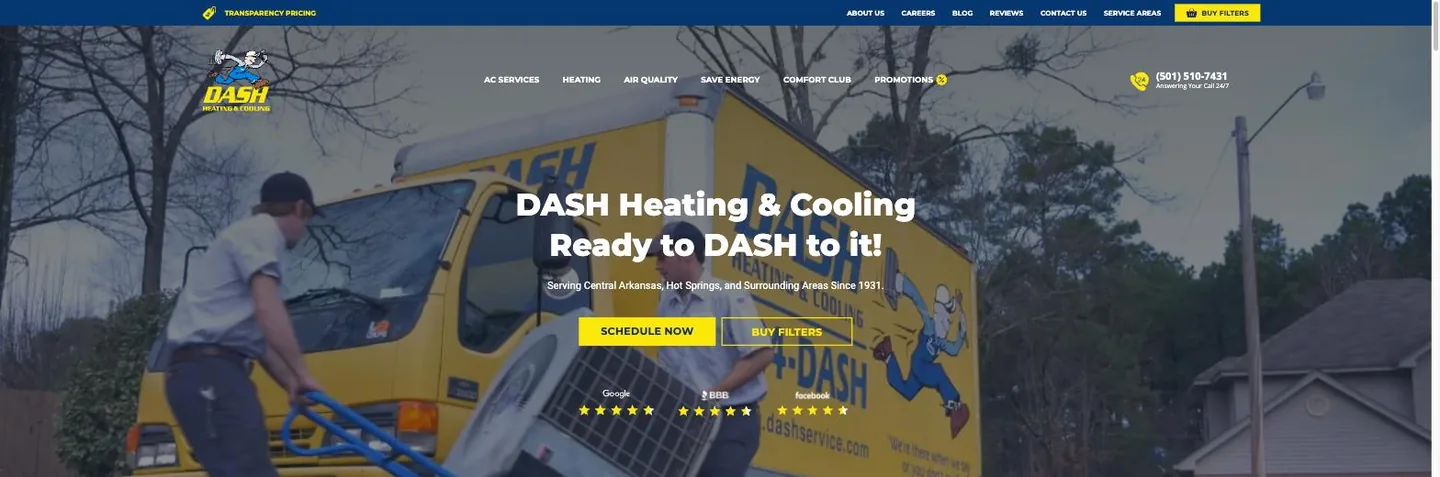
Dash Heating & Cooling
What it gets right
Real photograph of their own crew and their own branded truck, not a stock unit on a white background. Three review badges (Google, BBB, Facebook) sitting in the hero, which almost nobody does. A "Transparency Pricing" bar pinned above the nav, which answers the homeowner's actual first worry. And two CTAs doing different jobs: "Schedule Now" for the service call, "Buy Filters" for a repeat revenue line most contractors never build.
What we'd change
The headline is the company name plus a slogan. "Serving Central Arkansas, Hot Springs, and Surrounding Areas Since 1931" (the line that wins the search) is set small underneath it. Swap those two. The big type should carry the service and the region; the slogan can go small.
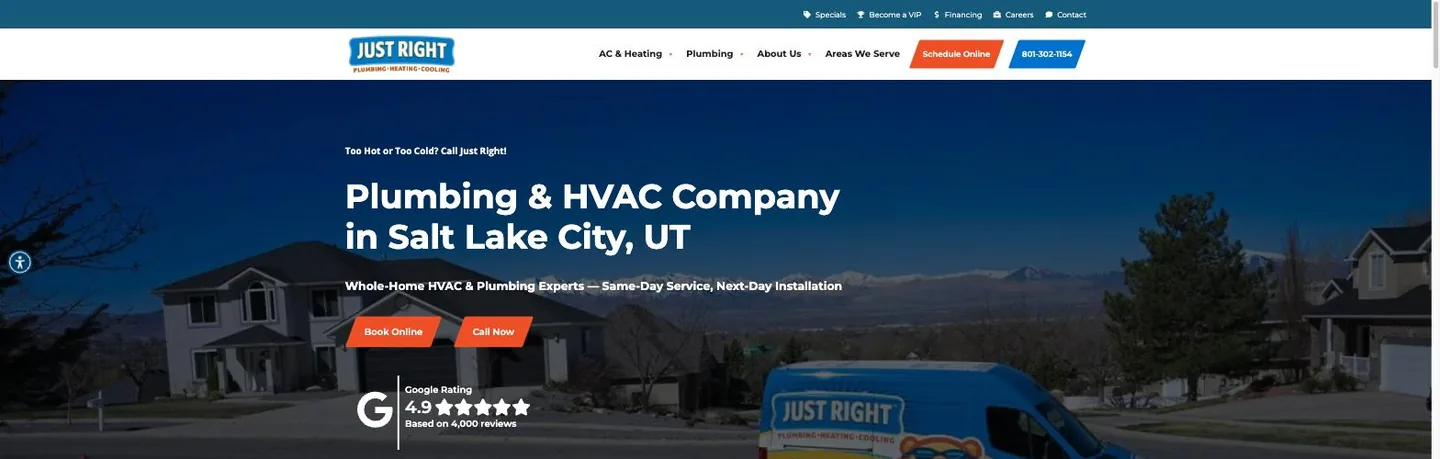
Just Right Plumbing Heating Cooling
What it gets right
The best headline of the eight: "Plumbing & HVAC Company in Salt Lake City, UT." Service and city, in the biggest type on the page, matching what the person typed. Underneath it, "Same-Day Service, Next-Day Installation", which is the only question an emergency caller has. Then a Google rating block, 4.9 from 4,000 reviews, right there above the fold. Book Online and Call Now sit side by side so the form-filler and the phone-caller each get their own door.
What we'd change
Very little. This is the template to copy. The one nit is a slightly crowded header: two nav rows plus a utility bar means the phone number competes with seven other links on mobile.
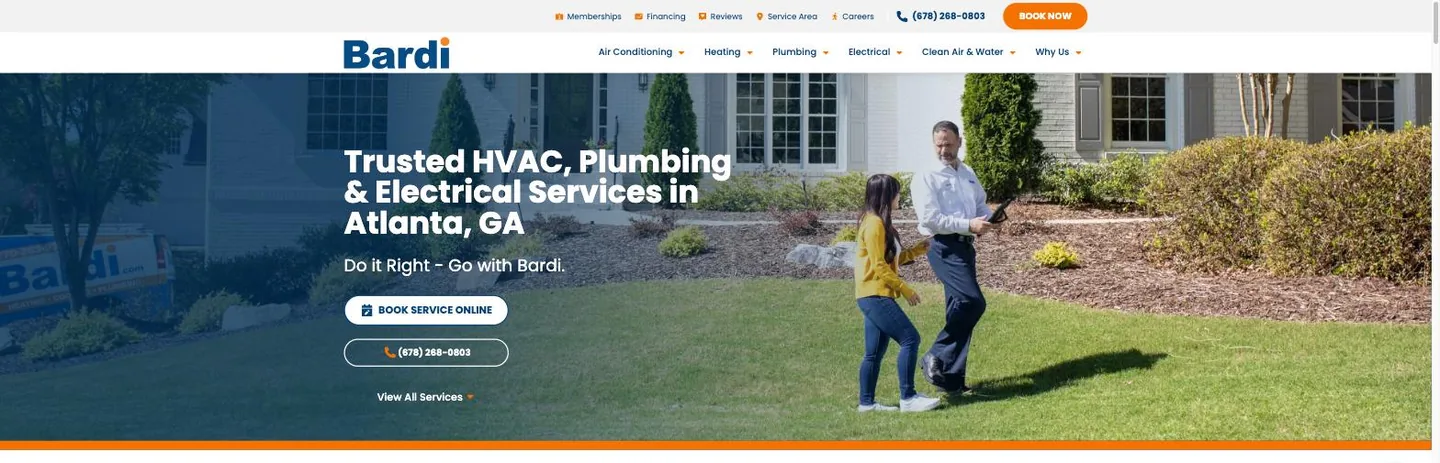
Bardi Heating, Cooling & Plumbing
What it gets right
City in the H1 again. The nav is organized by trade (Air Conditioning, Heating, Plumbing, Electrical, Clean Air & Water) which is how a customer thinks, not how the company is organized internally. "Book Service Online" is the primary button with the phone number stacked directly beneath it, so neither audience has to hunt. And the hero photo is a tech talking with a family, which does more trust-building work than another photo of a condenser.
What we'd change
"Do it Right - Go with Bardi" is the only supporting line, and it's a slogan rather than a claim. There's no proof above the fold (no rating, no years in business, no guarantee) on a site that has plenty of all three further down the page. Pull one of them up.
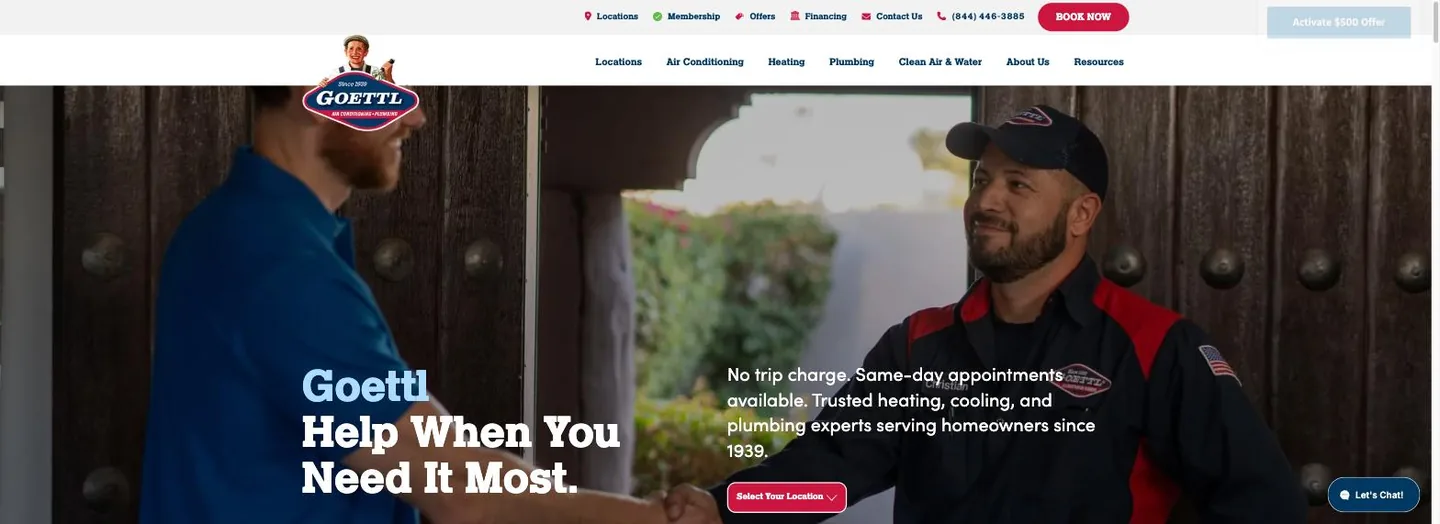
Goettl Air Conditioning & Plumbing
What it gets right
The hero copy is pure objection-handling and it's the sharpest on this list: "No trip charge. Same-day appointments available. Trusted heating, cooling, and plumbing experts serving homeowners since 1939." That's price fear, speed, and trust answered in one sentence, before anyone scrolls. The photo is a tech at a front door mid-handshake. The exact moment the customer is nervous about.
What we'd change
"Select Your Location" is the primary CTA, which puts a click between the visitor and booking. For a multi-market operator that's a real trade-off, but it can usually be solved with geolocation defaulting to the nearest market and a small "not your area?" link, rather than making everyone choose.
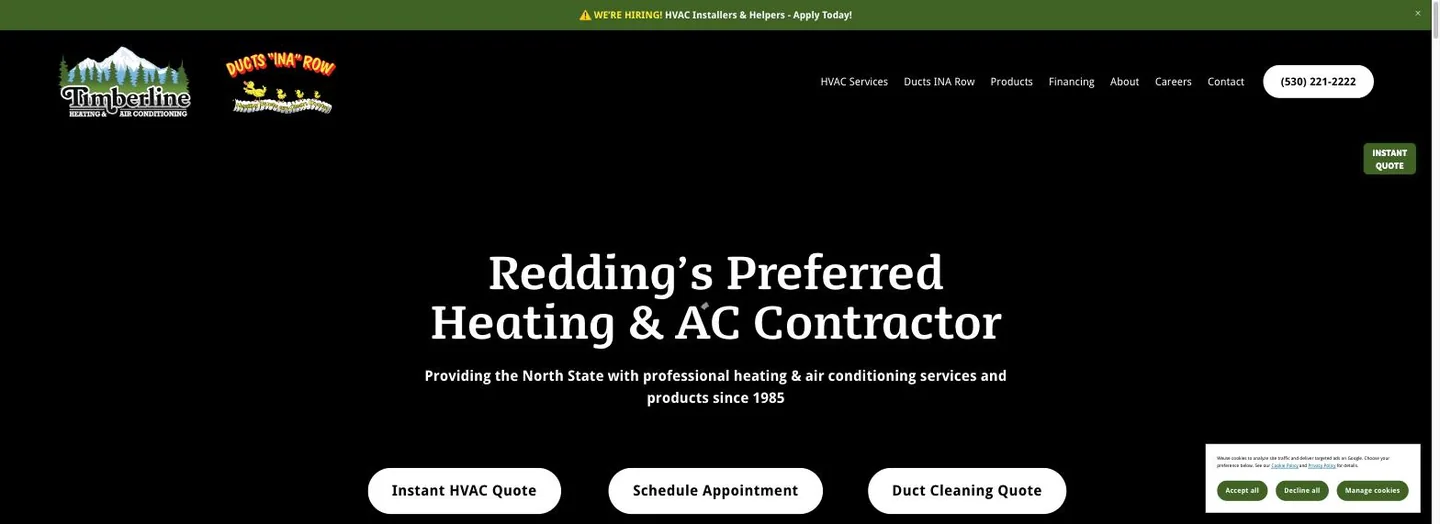
Timberline Heating & Air Conditioning
What it gets right
"Redding's Preferred Heating & AC Contractor": city first, and a claim rather than a description. Three CTAs for three different buyers: Instant HVAC Quote, Schedule Appointment, Duct Cleaning Quote. That "Instant Quote" tab pinned to the side of the screen is a real differentiator; most contractors make you fill out a form and wait. There's also a hiring banner across the top, which is the right instinct, in HVAC the bottleneck is usually techs, not leads.
What we'd change
The phone number is a button in the nav but doesn't stay put when you scroll. On mobile, where more than half of "AC repair near me" traffic comes from, a sticky tap-to-call bar is worth more than any other single change on this page.
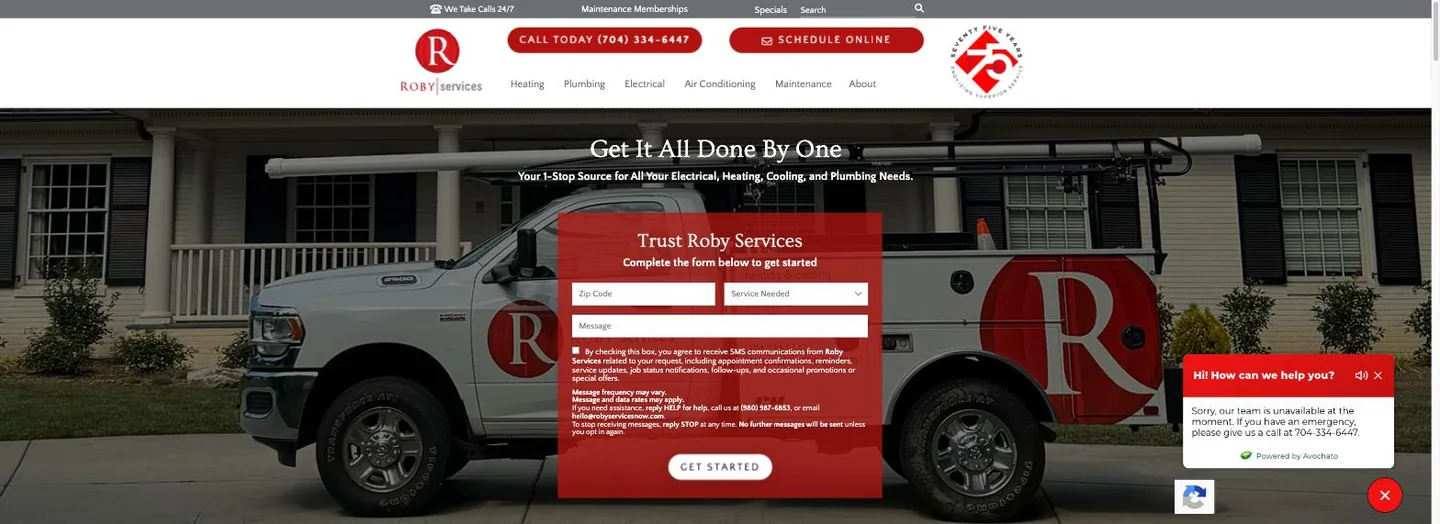
Roby Services
What it gets right
A short lead form sits directly in the hero (zip code, service needed, message) so there's no click between arriving and starting. "Call Today" and "Schedule Online" are both in the header, above the nav, in high-contrast buttons. The "Seventy Five Years" badge next to the logo does a lot of quiet trust work. And "Get It All Done By One" is a real positioning statement for a multi-trade shop rather than a generic welcome line.
What we'd change
The SMS consent paragraph inside the form is longer than the form itself, roughly eight lines of fine print under three fields. It's legally sensible and visually costly. Collapse it behind a "message & data rates apply" link with the full text one tap away.
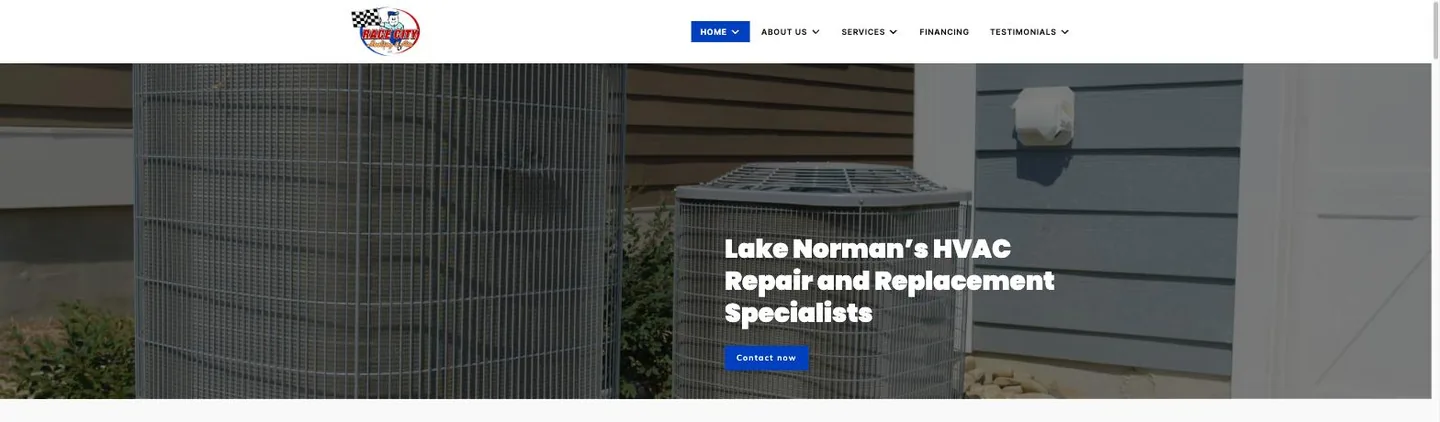
Race City Heating & Air
What it gets right
"Lake Norman's HVAC Repair and Replacement Specialists" names the area the way people who live here say it. Not "Iredell County," not "Greater Charlotte": Lake Norman. That kind of local phrasing is worth more than a list of city names, because it signals you're from here. The nav is short and plain, financing has its own tab, and the phone number appears in a call-out immediately below the hero.
What we'd change
"Contact now" is the only button above the fold, and it's the vaguest possible verb. "Schedule Service" or "Get a Free Estimate" tells the visitor what happens after the click, and that usually moves conversion more than anything else you can do in an afternoon.
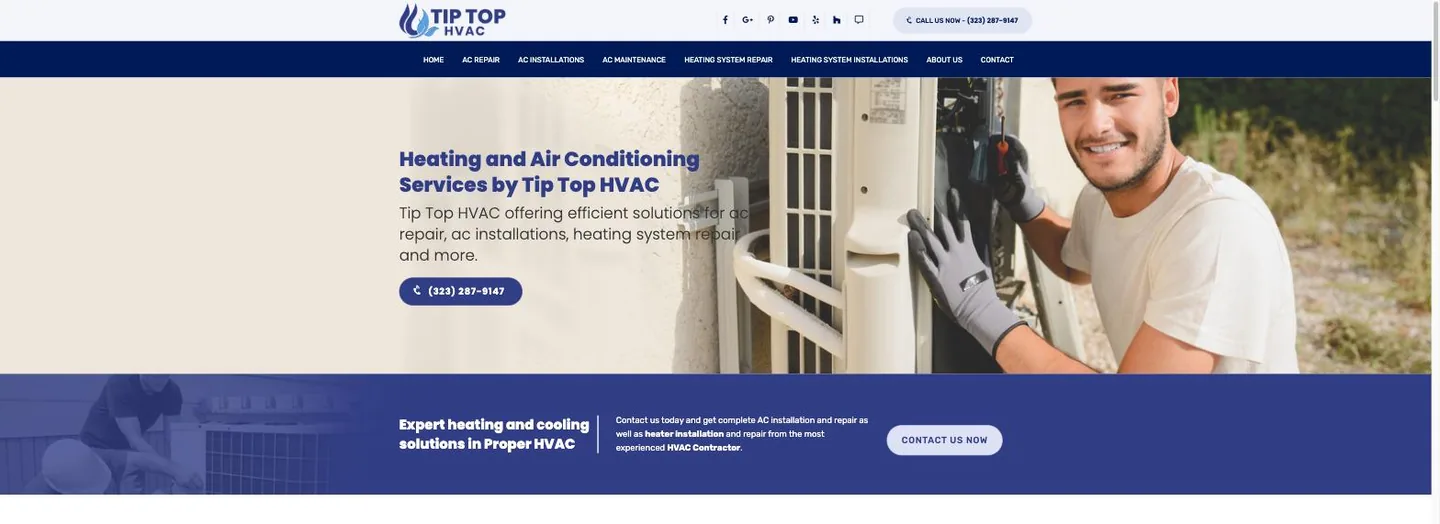
Tip Top HVAC, the cautionary one
What it gets right
It looks good: clean type, calm palette, fast. And the nav does the single most important structural thing correctly: every service gets its own item. AC Repair, AC Installations, AC Maintenance, Heating System Repair, Heating System Installations. Five services, five pages. That's the structure that ranks, and plenty of far more expensive sites get it wrong.
What we'd change
There is no city anywhere above the fold. And the band directly under the hero reads "Expert heating and cooling solutions in Proper HVAC": a template placeholder that was never replaced with a location. This is the whole lesson in one screenshot: a handsome site that cannot rank locally, because it never says where it works. Pretty is not the job.
What the eight of them have in common
Counting only what is visible above the fold, before any scrolling:
That last number is the interesting one. Every single company here has hundreds or thousands of Google reviews sitting on their profile, and six of the eight leave all of it below the fold or off the homepage entirely. Review proof is the cheapest trust signal in the trade and the most commonly wasted.
If you want a single afternoon's work that moves the needle on an existing HVAC site, it's this: put your city in the headline, put your star rating next to it, and make the phone number sticky on mobile. Those three changes cost nothing and beat most redesigns.
Want the same read on your site?
Send us your URL and we'll do this exact teardown on your HVAC site: above-the-fold audit, service page structure, mobile speed, and where you rank in your city. No charge, no pitch deck.
We build HVAC websites
Custom HVAC websites with separate repair, replacement, maintenance-plan and emergency pages, seasonal landing pages, financing information and tap-to-call on every screen. One-time builds from $2,497 you own outright, for HVAC companies anywhere in the U.S. Redesigning an older site? Our ranking-safe redesign process protects the rankings you already have.
The full HVAC website guide
Everything HVAC contractors need to build a site that books jobs: speed, service pages, seasonal SEO, cost ranges, and the mistakes that quietly bleed calls.
Intro
HVAC is a seasonal business with unseasonal websites. Most contractors we audit have a site that was built in winter five years ago, never touched since, and now loses jobs to shops with half the trucks and twice the online presence.
HVAC searches spike. A July heat wave in Charlotte can put a surge of "AC repair near me" searches in front of local contractors in a single week. Sites that handle that traffic win the season. Sites that load slowly, hide their phone number, or haven't updated pricing since 2021 watch the calls go somewhere else.
This guide covers what an HVAC website needs to do in 2026 to capture that seasonal demand and turn it into booked service tickets. We build these sites for HVAC companies across the Lake Norman area, and the site you're reading was built the exact same way.
Why HVAC Websites Fail Differently Than Other Service Websites
Plumbers get called in emergencies. Electricians get called after a project. HVAC sits in a weirder spot: half emergency, half planned capital expense. A tune-up call is nothing like a $12,000 system replacement, and your website has to handle both without looking confused.
The typical HVAC site gets this wrong in one of two ways.
Either it leans all-in on "EMERGENCY 24/7 SERVICE" and reads as a repair-only shop, leaving replacement and install dollars on the table. Or it leans on the big-ticket install side with equipment brochures and financing banners, and the homeowner with a dead compressor at 9 p.m. assumes you're not going to pick up.
Good HVAC sites hold both jobs at once. They make emergency service one click away and also walk a replacement buyer through brand options, financing, and the timeline. If your site does only one of those, you're half a business online.
The Seasonal Problem (And What to Do About It)
HVAC is the most seasonal service-business category there is. Search volume for "ac repair" in a typical North Carolina market looks like a hockey stick: flat through March, then up 400% by July, back down by October, then another smaller spike in January when heat pumps fail in the cold.
Your site has to work for that, and it won't by accident.
What works:
Pre-seasonal content, live before the season starts. A blog post titled "Signs Your AC Is About to Fail This Summer" published in April outperforms the same post in July. Google wants a few weeks to rank it. Ship early.
Service pages that separate maintenance, repair, and install. Three different buyers, three different pages. Lumping them together tanks the ranking on all three.
A "book a spring tune-up" or "fall furnace check" banner that swaps seasonally. The homepage shouldn't look the same in April as it does in October. Static HVAC sites give up on conversion half the year.
Email capture for the off-season. Customers who searched in September but didn't buy are worth retargeting in January. If your site has no email list mechanism, you lose them forever.
The 7 Things Every HVAC Website Needs
1. Phone number sticky to the top on every page. Not a callback form. Not a chat bot. A tappable phone number. HVAC is a call-first category. Always will be.
2. Service area stated in words: neighborhoods, not just city names. "Serving Mooresville, Cornelius, Huntersville, Davidson, Troutman, and the greater Lake Norman area." Google reads it. Customers trust it. If you work lakefront homes, a line about humidity load on waterfront heat pumps or higher cooling demand on sun-exposed lake houses lands with the right buyer before they call anyone else.
3. Separate pages for repair, install, maintenance, and indoor air quality. Four services, four pages. Each targeted at a different search and a different buyer.
4. Financing info visible. System replacements land in the $6,000–$15,000 range. If you offer financing through Wells Fargo, Synchrony, or a local partner, put the "as low as $X/month" language on every install page. You'll close more jobs just by saying it.
5. Brand badges for the equipment you install. Trane. Carrier. Lennox. Goodman. Buyers search by brand when they're comparing quotes. If your site doesn't show the brands you carry, you lose to the site that does.
6. Real reviews with real equipment issues called out. "John fixed our heat pump the same day we called" beats "Great service!" every time. Google's review generator will pull specifics if you ask the right way.
7. Mobile load time under 3 seconds. We say this on every service-business site because it's the thing that quietly kills every other thing on the list. Check yours at pagespeed.web.dev.
Hit those seven and you'll outperform most of the HVAC sites in any local market.
HVAC SEO: The Four Things That Move Rankings
Local SEO for HVAC runs on the same four levers as every trade, but the weights are different.
Google Business Profile. Weighted highest. Complete every field. Post weekly. Respond to every review within 48 hours. Upload new photos monthly: trucks, install projects, technicians at work. GBP on autopilot is GBP that's going backward.
Service-city pages. A dedicated page for "AC Repair Mooresville," a separate one for "AC Repair Cornelius," and another for "Heat Pump Repair Huntersville NC" outranks a single "Service Areas" page with bullet points, every time. You need one per city you want to rank in. Yes, this means 8-12 pages for a multi-city contractor. Worth it.
Reviews, weighted by recency. Google wants to know your business is still alive. 200 reviews from 2022 and none from 2025 signals a dead shop. A steady flow of 5-10 fresh reviews per month beats a review count three times as high that's gone stale.
NAP consistency across directories. Yelp, BBB, Angi, HomeAdvisor, Nextdoor, the chamber, Better Homes, manufacturer dealer locators (Trane, Carrier, etc). Same business name, same address, same phone on every one. Mismatches are a fast way to get demoted in the map pack.
Content marketing sits on top of that. Blog posts like "how often should I replace my HVAC filter" pull informational traffic that converts worse than "ac repair near me" but builds topical authority that lifts all your service pages.
What an HVAC Website Should Cost in 2026
A clear pricing breakdown.
DIY builders (Wix, Squarespace, GoDaddy): $15-$45 a month. You'll get a functioning site. The ceiling on ranking and conversion is low, but if you're a one-truck shop with no budget, use it for 90 days while you build cash flow.
Overseas freelancer (Fiverr, Upwork, etc): $400-$1,500. Mixed results. Read the contract. Make sure you own the site files, the domain, and the hosting login. The horror stories are real.
Local web designer / small agency: $3,500-$9,000 one-time + $100-$400/month hosting and maintenance. This is where most established HVAC contractors end up. You get a real site, someone local to call, and a platform you own.
Agency with SEO package: $8,000-$25,000+ upfront, plus $1,500-$5,000/month retainer. Fine if you're doing $5M+ a year and need a dedicated team. Overkill for most residential HVAC shops.
Subscription website design (managed website model): $200-$500/month, all-in. Build, hosting, ongoing SEO, updates, content. No upfront. Trade-off: ongoing commitment instead of a one-time purchase. We use one-time website builds with matching monthly hosting instead; see our website design packages.
The big pricing trap in HVAC specifically: agencies that charge $20K upfront and then another $3K a month for SEO, and the SEO is just a monthly PDF report. Ask any agency to show you the last three client sites they built and the current rankings. If they won't, walk.
The DIY-vs-Custom-vs-Subscription Decision for HVAC
Quick version.
DIY makes sense only if you're brand new, solo, and running off word-of-mouth. Do not expect it to rank. Plan on graduating off it within a year.
Custom one-time build makes sense if you have a clear brand, know your services and service cities cold, and want a site you own outright. Budget $5K-$10K for the build and another $2K-$5K a year for someone to maintain it.
Subscription makes sense for pretty much every other HVAC shop. Monthly fee, site is managed, SEO included, content added on schedule, updates happen automatically. The ROI math usually beats custom within 18 months because you don't hit the "our site is now outdated and we need $8K to redo it" cliff.
The worst pick is paying $6,000 for a custom site and then not touching it for four years. Which is what most HVAC contractors end up doing.
HVAC Website Design Mistakes We See Every Week
The greatest hits, ranked roughly by how much they cost you:
No mobile-friendly version. Phone number buried in the footer. Stock photos of generic HVAC units instead of your actual trucks and crew. No financing info on replacement pages. Service pages that list every brand and capability in one giant wall of text. Contact forms that ask for square footage, equipment age, and HOA name before you can even book a call. Blog posts dated 2019. "Serving the Greater Charlotte Area" without ever naming a specific city. No NC contractor license information shown anywhere on the site. No reviews on the homepage. A chat bot that can't answer "do you service Mooresville" without five back-and-forths.
Fixing any two of those is worth more than a full redesign.
Getting Started: A Realistic 30-60-90 Plan
If you're serious about fixing your HVAC website, this is the order that works.
First 30 days. Fix the seven non-negotiables on your current site. Get the phone number sticky. Rewrite the homepage so a visitor knows where you service and what you do within five seconds. Add real photos. Claim and complete your Google Business Profile. Set up a review request system that triggers after every completed job.
Days 30-60. Build out separate service pages for each major offering: AC repair, heat pump install, furnace service, indoor air quality, duct cleaning. Each with the city names you target. Start asking happy customers for reviews every week.
Days 60-90. Launch pre-seasonal content. Write three blog posts aimed at homeowner questions ("how long does an AC unit last," "signs your furnace is dying," "what size HVAC system do I need"). Add a tune-up landing page ready to activate in spring and fall.
You can do that on any of the three build paths above. The path matters less than the execution.
How to Know If Your HVAC Website Is Working
Four numbers. Check them monthly.
Calls from the website. Use a tracking number on the site that's different from your main line. If you're not tracking this, you're flying blind.
Form submissions that convert to booked service. Not all leads are equal. Track the ratio.
Average position in Google for your top 10 keywords. Use Google Search Console. Free. Takes 10 minutes to set up.
Mobile page speed score. pagespeed.web.dev. Aim for 80+.
If three of those four are trending the wrong way, the site is the problem. If they're trending up, the site's doing its job and the rest of the business just needs to keep up.
FAQ
What does a good HVAC website look like in 2026?
Across the eight live HVAC sites we screenshotted for this guide, the pattern is consistent: a phone number in the header on every single one, the service and city stated in the hero on five of eight, and two or more calls to action above the fold on five of eight. The biggest gap (and the easiest place to beat your competition) is review proof: only two of the eight put a star rating above the fold, even though every one of them has hundreds or thousands of reviews sitting on their Google profile.
How much does a good HVAC website cost in 2026?
Most established HVAC contractors land somewhere between $3,500 and $9,000 for a one-time custom build plus ongoing maintenance, or $200 to $500 per month on a subscription model that bundles build, hosting, and SEO. DIY builds run under $50 a month but cap out fast on ranking. The "right" cost depends less on budget and more on whether you want a one-time expense or a managed monthly line item.
How long does it take to build an HVAC website?
Two to four weeks for a custom build assuming the contractor is responsive with photos, service list, and review content. Subscription models typically launch a v1 in 10-14 days. Template DIY builds can be up in a weekend, though the ranking ceiling is lower.
Do HVAC companies need separate pages for each service?
Yes. Bundling AC repair, furnace install, and indoor air quality onto one "Services" page dilutes ranking across all three. Google ranks pages, not sites, and homeowners searching "AC repair Mooresville" expect to land on a page that's specifically about AC repair in Mooresville.
Should I publish pricing on my HVAC website?
Ranges beat exact numbers. "Service call $89-$129," "full system replacement typically $6,000-$12,000 depending on size and efficiency." Homeowners who know your ballpark call more often than ones who have to fish for it. Competitors aren't winning by keeping prices secret.
What's the best platform for an HVAC website?
WordPress on managed hosting handles most HVAC sites well. Subscription website design platforms are fine if the underlying tech is still WordPress or similar and you can export your content if you leave. Stay away from proprietary builders that lock your content in their system.
How do I get my HVAC website to rank in Google Maps?
The map pack (the three local results above the regular listings) is driven primarily by Google Business Profile completeness, review volume and recency, proximity to the searcher, and NAP consistency across directories. Your website supports the map pack but doesn't drive it directly. Start with GBP.
Do I need a blog on my HVAC website?
Not to rank for your own city, usually. But blog content helps rank for "near me" searches in surrounding cities, captures informational traffic (filter changes, system lifespan, sizing questions) that converts into service calls, and builds the topical authority that lifts all your other pages. Add one post a month and you'll feel the lift within six.
Why isn't my HVAC website getting calls?
Most likely: the phone number isn't visible fast enough on mobile, the site loads slowly, your service area isn't clearly stated, or your Google Business Profile is incomplete. Those four things cost you 70% of the calls a decent site should generate. Fix them before you consider a full redesign.
Is it too late to fix my HVAC website mid-season?
No. Mid-summer is a good time for the quick fixes. Sticky phone number, faster mobile load, and a visible service area can be shipped in days and start converting the peak-season traffic you're already getting. What you should NOT do mid-season is a full redesign or platform migration; save the teardown for September-October, after cooling season and before heating season. Fix the call-capture leaks now, rebuild in the shoulder season.
Do you build HVAC websites outside of Mooresville?
Yes, we build for HVAC contractors across Lake Norman (Cornelius, Davidson, Huntersville, Troutman), the greater Charlotte metro, and the broader Iredell and Mecklenburg counties. The fundamentals are the same whether the shop is in Mooresville or Concord: separate service pages by city, NAP consistency across Trane/Carrier dealer locators, real photos of trucks and crews, fast mobile load, and seasonal content shipped before the season starts. What changes is which neighborhoods and which manufacturer directories matter. If you're outside our usual footprint and want a local-feeling site from a North Carolina team, send us a note and we'll tell you straight whether we're the right fit.
Screenshots above were captured from each company's live homepage on August 1, 2026, and are used for commentary and review. All trademarks belong to their respective owners; none of these companies are affiliated with Mooresville Marketing.
Mooresville Marketing builds HVAC websites across Lake Norman (Mooresville, Cornelius, Davidson, Huntersville, and Troutman) and the broader Charlotte metro. The site you're reading is the same kind of site we'd build for your shop. Compare the website packages or send us a note if you want to talk through what your site needs next.