How we picked these five
Every screenshot below was captured from the live site on August 1, 2026, at desktop width, top of the homepage. The exact slice a homeowner sees with water on the floor and no patience. No mockups, no concept renders. Three are out-of-market shops in Texas and Arizona; two are here in the Lake Norman area.
Plumbing is the most unforgiving category on the web. Nobody browses for a plumber. They search, they skim two or three sites in about forty seconds, and they call whoever makes the decision easiest. So the only question we're asking of each site is: does this page tell a stranger what you do, where you do it, and how to reach you, before they scroll?
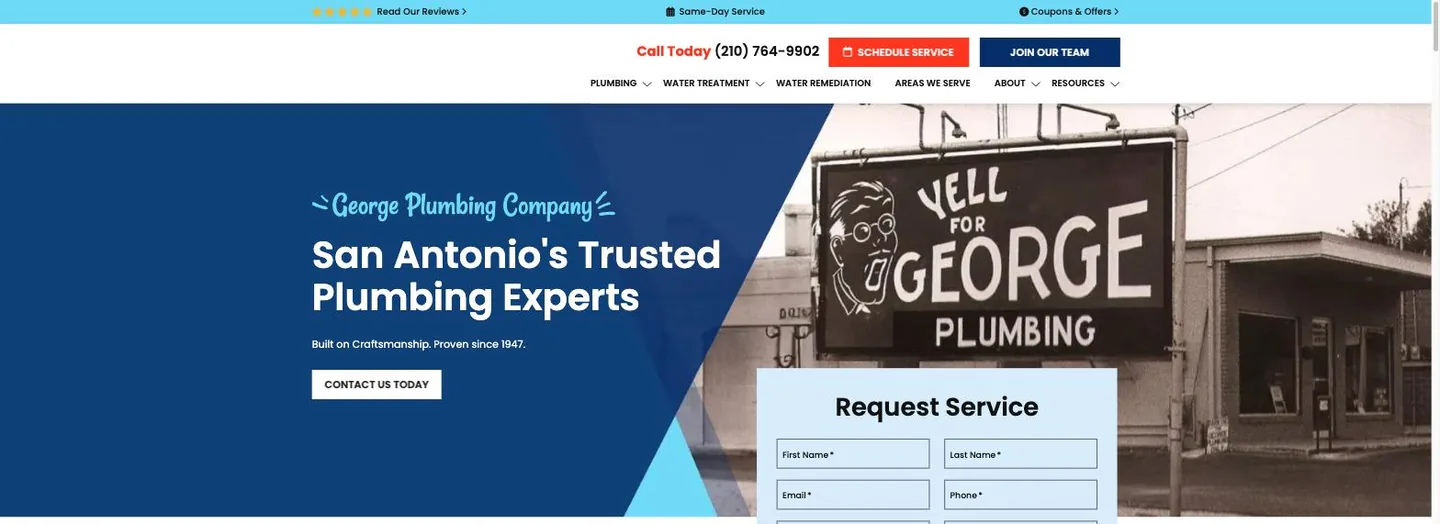
George Plumbing Company
What it gets right
Almost everything, and it starts with the photograph, the original hand-painted "Yell For George" sign from the company's own history, not a stock photo of a wrench. "San Antonio's Trusted Plumbing Experts" puts the city in the biggest type on the page. "Built on Craftsmanship. Proven since 1947" does the trust work in eight words. There's a Request Service form in the hero, a phone number and a Schedule Service button in the header, star ratings in the utility bar, and a "Join Our Team" CTA for recruiting. Five different jobs, one screen, none of them fighting.
What we'd change
"Contact Us Today" is the only button on the left side, and it's the weakest verb available on a page that otherwise sells hard. Make it "Schedule Same-Day Service" and it does the same job while telling the visitor what happens next.
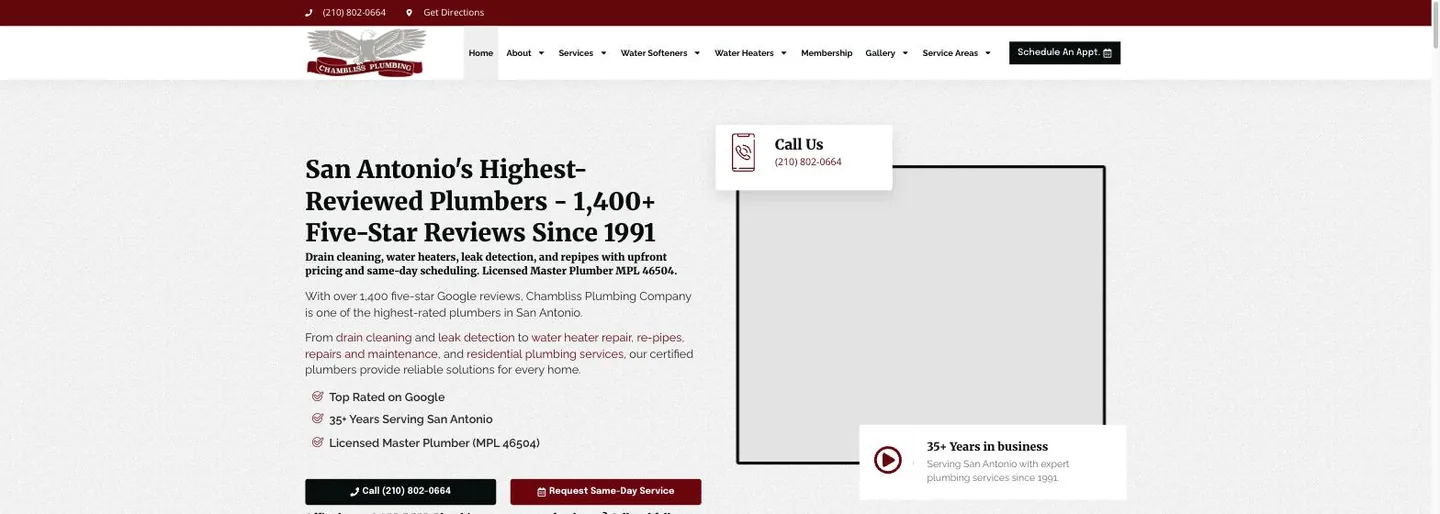
Chambliss Plumbing Company
What it gets right
The headline is the proof: "San Antonio's Highest-Reviewed Plumbers: 1,400+ Five-Star Reviews Since 1991." Most contractors bury the review count on a testimonials page. This one made it the H1. Underneath: upfront pricing, same-day scheduling, and the licence number in plain text, Licensed Master Plumber MPL 46504. Three trust bullets, then two buttons that split the traffic properly (Call, or Request Same-Day Service). If you only steal one idea from this whole page, steal this headline structure.
What we'd change
The hero video hadn't painted when we captured it, leaving a large empty rectangle in the right half of the screen. A poster image behind the video would keep that space working even when the file is still loading, which on a phone, on cellular, in a bathroom with a burst supply line, is most of the time.
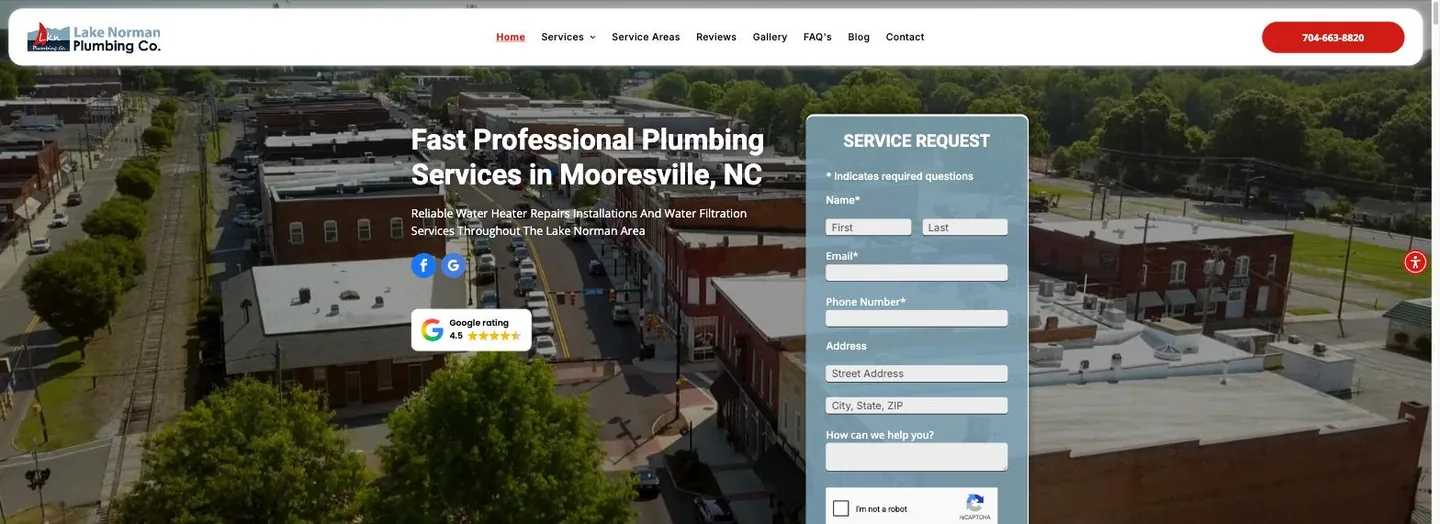
Lake Norman Plumbing Co.
What it gets right
The hero image is a drone shot of downtown Mooresville: actual Main Street, recognisable to anyone who lives here. That single choice does more local trust-building than any amount of "proudly serving the community" copy. "Fast Professional Plumbing Services in Mooresville, NC" is a clean service-plus-city H1, the Google rating badge sits right under it, and there's a full service request form in the hero with the phone number in a red button up top.
What we'd change
A full-screen promo modal fires on load and covers the whole hero (the headline, the rating, the form, all of it) until you find the X. Offers convert, but not before the visitor knows who you are. Delay it to a scroll trigger or an exit intent and it stops costing you the first impression.
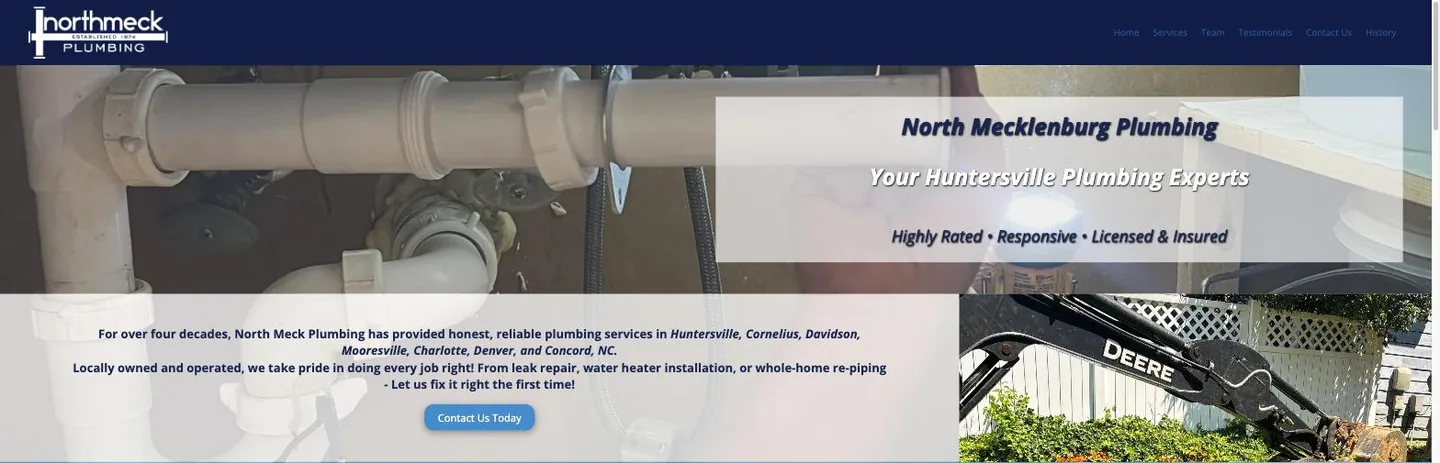
North Mecklenburg Plumbing
What it gets right
It names every city, in words, right at the top: Huntersville, Cornelius, Davidson, Mooresville, Charlotte, Denver, and Concord. That is exactly what Google reads and exactly what a homeowner in Denver, NC needs to see before they call. "Your Huntersville Plumbing Experts" claims the home market plainly, "Established 1974" sits in the logo, and the hero photo is real pipework from a real job rather than a stock image.
What we'd change
There is no phone number anywhere above the fold, not in the header, not in the hero, not in the nav. For a plumber, that's the single most expensive omission possible, and it's also the cheapest one to fix: one tap-to-call button in the header, sticky on mobile, changes the economics of every visit to this page.
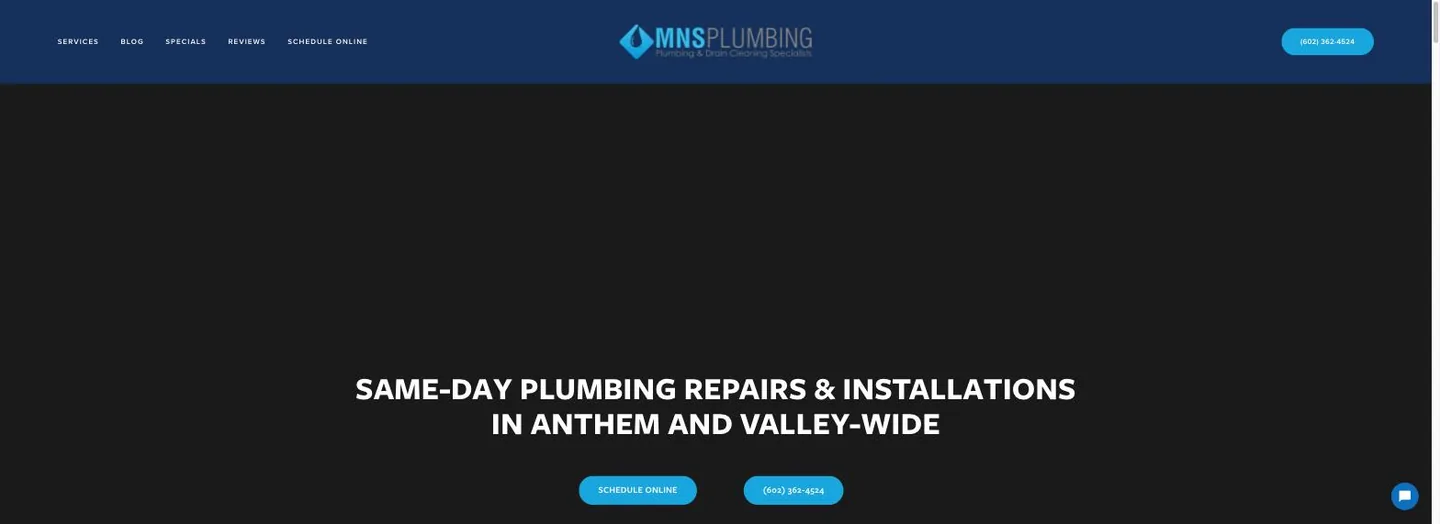
MNS Plumbing, the cautionary one
What it gets right
The headline is excellent: "Same-Day Plumbing Repairs & Installations in Anthem and Valley-Wide." Speed, service, and service area in one line, which is all three things a plumbing searcher wants. Schedule Online and the phone number sit side by side beneath it, and the phone number is repeated as a button in the header. On copy alone this competes with anything else on this page.
What we'd change
What you're looking at is what we saw: a background video that still hadn't painted seven seconds after the page loaded, on a desktop, on a fast connection. Everything above the headline is empty. That is the most common expensive mistake on plumber websites. A heavy video hero that looks great in the design review and blank on a phone. A static hero image would cost this site nothing and give it back seven seconds.
What separates the good ones
Five sites is a small sample, but the split is clean and it matches what we see auditing plumber sites every week. The two strongest, George and Chambliss, both do the same four things in the first screen:
The weaker screens fail on one of those four, and it's almost never a budget problem. North Meck names seven cities correctly and then leaves the phone number off the top of the page. MNS writes a better headline than most agencies would and then hides it behind a video that doesn't load. Lake Norman puts real Mooresville rooftops in the hero and then covers them with a popup.
None of those are redesigns. They're afternoons. If your plumbing site is losing calls, start by opening it on your own phone and counting the seconds before the number is tappable. If it's more than two, you've found the first fix.
Want this read on your own site?
Send us your URL and we'll run the same teardown on your plumbing site: above-the-fold audit, service page structure, mobile load time, and where you rank in your town. No charge, no pitch deck.
We build plumber websites
Custom plumbing websites with separate emergency, drain, sewer and water heater pages, tap-to-call on every screen, and your license and reviews up front. One-time builds from $2,497 you own outright, for plumbers anywhere in the U.S. Already ranking and worried a new site will cost you? Our ranking-safe redesign process protects the pages Google already likes.
The full plumber website guide
What a plumber website needs in 2026 to get found, earn trust, and turn visitors into booked jobs. Real examples, costs, mistakes to avoid, and a step-by-step build.
Intro
If you're a plumber and your phone isn't ringing the way it used to, the problem usually isn't your trucks, your techs, or your pricing. It's that your website is quietly losing the call before it ever happens.
People don't pick plumbers the way they did ten years ago. They search. They skim three sites in about forty seconds. They book whoever looks most trustworthy, loads the fastest, and makes the "call now" decision easy. If your site isn't built for that thirty-second window, the job goes to the shop down the road, even when you do the better work.
This guide is what we'd tell any plumber who sat down at our table and asked, "what should my website look like in 2026?" It covers what converts, what ranks, what it should cost, and the traps that keep good plumbers stuck with bad websites for years.
We build plumber websites for a living, and our own site you're reading right now was built the same way we'd build yours. So everything below is what we practice, not theory.
Why Most Plumber Websites Lose Customers Before They Call
Most plumber sites fail for the same handful of reasons, and they're almost never about how the site looks.
The number one issue is speed. A slow site on a phone kills the call before the homepage even finishes loading. Google's own research pegged the drop-off: the chance a visitor leaves jumps sharply when a page takes more than three seconds to load. Plumbing searches happen on mobile, under pressure, often with water already on the floor. If your site stalls, they're gone.
The second issue is trust. When the site looks like it was built in 2014, has stock photos of someone else's trucks, or uses a phone number that doesn't match what's on Google: visitors assume you're either out of business or not the real operator. They don't call to find out.
The third issue is friction. Too many plumber sites hide the phone number in the footer, use a contact form with seven required fields, or force people to scroll through a company history before they can book a service. In a plumbing emergency, that's the same as saying "call someone else."
Fix those three things and you've already outperformed about seventy percent of plumber sites in your service area.
What a High-Converting Plumber Website Does
Start with the job. A plumber website has exactly one purpose: convert a stranger with a problem into a booked job.
Everything else (the animations, the "About Us" video, the team bios) is secondary. Pretty doesn't pay. Booked jobs pay.
A website that does that job well has three things happening at once:
It tells the visitor within five seconds that (a) they're in the right place, (b) you service their town, and (c) they can reach you right now.
It makes the next step obvious and singular. One phone number. One "request service" button. Not three CTAs fighting each other.
It earns just enough trust, fast. Real photos of real trucks. Real reviews with real names. License and insurance info visible without a scavenger hunt.
If your site does those three things in the first screen a visitor sees, the rest of the site is mostly insurance. If it doesn't, no amount of redesign below the fold will save it.
The 7 Non-Negotiables Every Plumber Website Needs in 2026
The short list is below. Every plumber website we build includes all seven.
1. A phone number locked to the top of every page. Sticky header, tap-to-call on mobile. Not in a hamburger menu. Not in the footer. Visible the second the page loads.
2. Real photos of your trucks, your crew, and your actual work. Stock photos read as fake in 2026. Phone photos of your real team shot in natural light outperform professional stock every time.
3. A service area that's spelled out in words. "Serving Mooresville, Cornelius, Huntersville, and the greater Lake Norman area", not just a map pin. Google reads the words. So do your customers.
4. Service pages for each of your top services. One page for water heater repair. One for drain cleaning. One for sewer line replacement. One for emergency plumbing. Separate pages rank for separate searches.
5. Reviews visible on the homepage. Not buried on a "testimonials" page. Three to five real reviews, with real first names and real towns, on the first screen.
6. Licensing, insurance, and warranty info in plain sight. Your North Carolina plumbing license number: P-1 or P-2 depending on scope. "Licensed and insured." Whatever warranty you offer. These are trust signals that cost nothing and make a difference.
7. A site that loads on mobile in under 3 seconds. This is the invisible one. Run your site through Google's PageSpeed Insights. If you're under 50 on mobile, nothing else on this list matters. The site is leaking customers faster than you can fill it.
That's it. Seven things. Every plumber website design decision should serve those seven; anything else is decoration.
Plumber Website Design Examples: What Works and What Doesn't
We look at a lot of plumber websites. The patterns repeat.
The ones that work share a look you can spot in half a second. A wide hero image of the actual crew or truck. A big, readable phone number. A one-line promise ("24/7 emergency plumbing in Lake Norman"). Three clear service buttons below the hero. If you work waterfront homes around the lake, a line about older pipe systems in lakefront properties lands with the right customer before they even read the rest of the page. Reviews visible without scrolling. A footer with the license number, address, and hours.
The ones that don't work also share a look. A slideshow of stock photos that loads slowly. A headline like "Quality Plumbing Solutions for Your Home and Business." A generic "Get a Quote" form with eight fields. A hamburger menu that hides every service. A phone number only visible after tapping a menu.
The difference isn't design budget. It's design discipline. Good plumber sites say less, more clearly. Weak plumber sites try to look corporate and end up looking generic.
If you want a quick gut check, pull up your own site on your phone. Count the seconds until the phone number is tappable. If it's more than two, that's the first thing to fix.
SEO Fundamentals for Plumber Websites
Design gets them to call. SEO gets them to find the site in the first place. For plumbers, local SEO matters more than almost any other small-business category, because plumbing searches are almost always location-based: "plumber near me," "water heater repair Mooresville," "emergency plumber Cornelius," "plumber Huntersville NC," "24/7 plumbing Lake Norman."
There are four things that move local rankings for plumbers, and they stack in roughly this order:
Google Business Profile, set up properly. Your profile is doing more than half the work. Complete it fully: every service, every photo, every attribute. Post updates weekly. Respond to every review, good and bad, within forty-eight hours.
Service pages optimized for the exact searches people make. A page titled "Water Heater Repair in Mooresville, NC" ranks for that search. A page titled "Emergency Plumber in Huntersville, NC" ranks for a different one. A page titled "Our Services" ranks for nothing. Break out every major service into its own page with the town name in the title and URL.
Reviews, consistently, forever. Google weights recent reviews heavily. A plumber with 80 reviews from 2022 loses to a plumber with 40 reviews from the last six months. Build a system, a text after every job, that keeps them flowing.
Local citations and links. Your name, address, and phone number listed consistently across directories (Yelp, BBB, Angi, HomeAdvisor, the local chamber). Inconsistent NAP data across directories is one of the fastest ways to tank local rankings.
Content marketing (blog posts, guides like this one) is the tier above that. It's how you move from ranking for your own town to ranking in neighboring towns, and how you start showing up for informational searches like "how long should a water heater last." But if the four fundamentals above aren't in place, content won't save you.
How Much Should a Plumber Website Cost in 2026?
There's a wide range, and most of the range is noise. This is how it breaks down.
DIY on a template builder (Wix, Squarespace, GoDaddy): $15–$40 a month, plus your time. You'll get a site. It probably won't rank. It probably won't convert at the level a custom site will. For a brand-new plumber with zero budget, it's a reasonable starting point for ninety days.
Low-end freelancer or offshore build: $500–$1,500 one-time. Quality varies wildly. You may end up with a site you can't edit, hosted somewhere you don't control, built on a platform you don't own. Read the contract carefully.
Local agency, custom build: $3,000–$8,000 one-time for the build, plus $100–$400 a month for hosting and maintenance. This is where most plumbers should probably land. You get a site that's yours, built around your services and service area, with someone local accountable for keeping it running.
Subscription website design (managed website model): $200–$500 a month, all-in. Build, hosting, updates, SEO, and ongoing optimization bundled. No upfront cost. Trade-off: you don't "own" the site the same way, but you don't get stuck with an outdated custom site in three years either. This is the model we run ourselves, and the model we'd pick if we were starting over.
The truth is that the price range from $3,000 to $20,000 mostly reflects the agency's overhead, not the quality of the site. A well-built plumber site with the seven non-negotiables above doesn't need to cost $15,000. Be skeptical of quotes that can't explain exactly what's included and how it drives booked jobs.
DIY, Custom, or Subscription: Which Path Fits You
A few quick rules.
Pick DIY if you're brand new, have zero budget, and need something up this week. Use it for ninety days. Plan to graduate off it.
Pick a custom build if you have an established shop, know your services and service area well, have a clear vision, and have $5,000+ to put in. You'll get something tailored and you'll own it outright.
Pick a subscription if you want the "done for you" model (a real website, managed, updated, optimized, with no surprise bills) and you'd rather predict a line item each month than drop five figures once. This is the model that fits most small plumbing shops best, which is why subscription website design has taken over that segment.
Whatever you pick, the worst option is the forever-in-progress option. A plumber site that's been "getting redone soon" for two years is costing you more than any of these paths would have.
Common Plumber Website Mistakes to Avoid
Short list of the ones we see most often:
Burying the phone number. Using stock photos of plumbers that clearly aren't you. Treating the contact form like a loan application. Writing copy that reads like a corporate brochure ("delivering excellence in plumbing solutions since..."). Forgetting mobile entirely. Letting the site go six months without a content update. Claiming service areas you don't cover. Skipping the service-area page because "Google knows where we are." Adding a live chatbot that gives worse answers than a human could. Hiding reviews. Hiding pricing so aggressively that visitors assume you're expensive.
Every one of these costs you calls. Most of them are free to fix.
How to Get Started
If you've read this far, you probably already know what you need to do. A few concrete first steps, in order:
Pull up your site on your phone. Time how long it takes to load. Time how long it takes before the phone number is tappable. If either is over three seconds, that's the first fix.
Check your Google Business Profile. Is every service listed? Are you posting? Are you responding to reviews? If not, that's the second fix.
Look at your top three competitors in your town. Not to copy them, to see what gap they leave open. Most plumber sites in any given town are roughly the same. The one that gets specific about a neighborhood, a service, or a kind of customer wins.
Then decide which of the three build paths above fits your situation. And start. The plumber who ships a good-enough site this month beats the plumber who's been designing the perfect site for a year.
If you want help thinking through any of this, we do this work every day. We build websites for plumbers, HVAC techs, and trades across the Lake Norman area and beyond. See our website design packages for the build options and process, or reach out here for a straight assessment of your current site.
FAQ
How much does a good plumber website cost?
Most small plumbing shops land in one of three ranges: under $500 total on a DIY builder, $3,000–$8,000 for a one-time custom build with a local agency, or $200–$500 a month for a subscription that bundles build, hosting, and optimization. What matters more than the price tag is whether the site converts visitors into booked jobs.
How long does it take to build a plumber website?
A well-built plumber website takes two to four weeks when the plumber is responsive with content (photos, service list, reviews, license info). Template builds can be up in a day. Subscription website design models typically launch a first version in one to two weeks and iterate from there.
Do plumbers really need a website in 2026 if they have Google Business Profile?
Yes. Your Google Business Profile is doing the most work for local search, but it doesn't give you control over how you're presented, doesn't house the full story of your services, and doesn't work when customers find you through directory listings, Facebook, or referrals. A website is the one piece of the stack you own.
What's the best platform for a plumber website?
For most plumbers, WordPress on managed hosting or a subscription website design model both work well. The platform matters less than how the site is built and whether someone is maintaining it. Avoid platforms where you can't export your content if you ever want to leave.
How do I get my plumber website to rank on Google?
Four things, in order: a complete Google Business Profile, service pages for each of your top services with town names in the titles and URLs, a steady flow of recent reviews, and consistent name/address/phone data across local directories. Everything else (blog posts, backlinks, content marketing) sits on top of that foundation.
Should I include pricing on my plumber website?
Publishing exact prices is hard because plumbing jobs vary. What works is publishing price ranges for common jobs, a service-call fee, and a clear "free estimate" policy for bigger work. Plumbers who give visitors a sense of cost convert better than plumbers who force a phone call just to get a ballpark.
Do I need a blog on my plumber website?
You don't need one to rank for your own town. You likely need one to rank in neighboring towns, to rank for informational searches ("how long does a water heater last"), or to build trust with customers who research before they call. A blog is an upgrade, not a foundation.
What should I do if my current plumber website isn't bringing in calls?
Start with the seven non-negotiables in this guide. Audit where the site is failing each one. Nine times out of ten, the problem isn't that the site needs a full redesign. It's that the phone number is buried, the site is slow on mobile, or the service pages don't exist. Those fixes are fast and cheap.
Do you build plumber websites outside of Mooresville?
Yes, we build for plumbers and service trades across Lake Norman (Cornelius, Davidson, Huntersville, Troutman), the greater Charlotte metro, and the broader Iredell and Mecklenburg counties. The fundamentals are the same whether the shop is in Mooresville or Concord: service-area pages, local citations, real photos, fast mobile load. What changes is which neighborhoods and which review directories matter. If you're outside our usual footprint and want a local-feeling site from a North Carolina team, send us a note and we'll tell you straight whether we're the right fit.
Screenshots above were captured from each company's live homepage on August 1, 2026, and are used for commentary and review. All trademarks belong to their respective owners; none of these companies are affiliated with Mooresville Marketing.
Mooresville Marketing builds websites for plumbers, HVAC companies, electricians, and service trades across Lake Norman (Mooresville, Cornelius, Davidson, Huntersville, and Troutman) as well as the greater Charlotte metro. The site you're reading right now is the same kind of site we'd build for your shop: same hosting, same SEO approach, same strategic foundation. compare the website packages or send us a note.